Showing posts with label alternative photography. Show all posts

Tuesday, March 8, 2011

Playing with Liquid Light

Last rotation, I spent a few weeks experimenting with getting some actual results with Liquid Light liquid photographic emulsion. It took me a few failed attempts involving major over or underexposure of the photo, as well as trouble with getting the Liquid Light to stick to certain materials (mainly metals) and an incident with fixer reacting with a metal sheet to produce sulfur somethingorother.

However, I finally stumbled upon the winning combination of using unreactive materials (such as paper and aluminum) that had rough or roughened surfaces and produced some successful results. The trick was that some materials such as metal, which have smooth surfaces, had to first be roughened either by sanding or primer in order to make the Liquid Light emulsion stick throughout the development process.

A few tips:
1. Liquid Light is sensitive to yellow and amber safety lights over short periods of time, but if you work in a very dark room, such as one used for loading film, you can crack the door open slightly to get a tiny, tiny bit of ambient light to work with. It won't expose the Liquid Light, and it's much easier to coat your objects with light than in the dark.

2. Let the Liquid Light dry before exposing it. If you try and expose a wet Liquid Light photograph, then it will more often than not be massively overexposed.

3. When developing the exposed Liquid Light object, don't agitate the object too much in the developing chemicals, because the emulsion has a tendency to become wet again if it's on nonporous objects (like metal) and it may fall off the surface if it hasn't been properly prepared.


Below are some examples:

The metal sheet to the right is the one that reacted with the fixer to produce sulfur. I believe it was made of galvanized tin or steel.

I had great success with using recycled mat card pieces, as shown on the left side.

Unreactive metal such as stainless steel and aluminum also works.

The dish in the center is aluminum with a white primer coating on it.

Thursday, January 13, 2011

Example: Alternative Photography- Scanograms

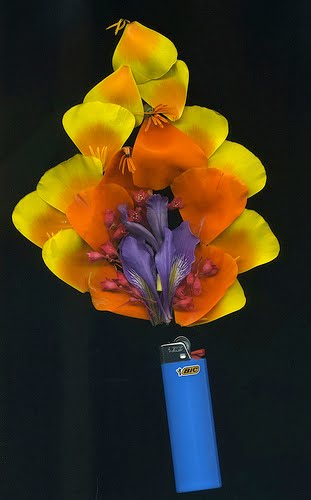
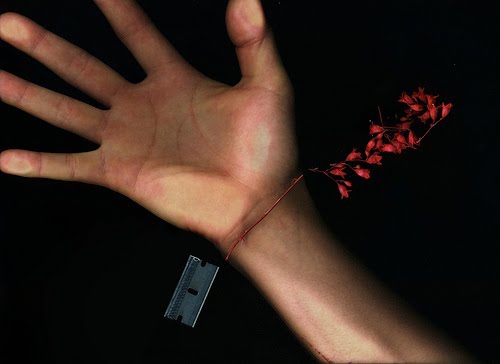
Scanograms are photographs made by placing objects on a flatbed scanner and then taking a photograph by scanning said objects. They can be quite interesting due to their depth of field and dramatic lighting effects. I particularly love the vivid colors in the examples below.


http://www.flickr.com/photos/austin_long/3488455102/

http://www.flickr.com/photos/austin_long/3487641619/

http://www.flickr.com/photos/austin_long/4096853953/in/set-72157617413315225/

Example: Alternative Photography- Lumen Printing

I recently discovered a form of alternative photographic printing called the Lumen printing process.

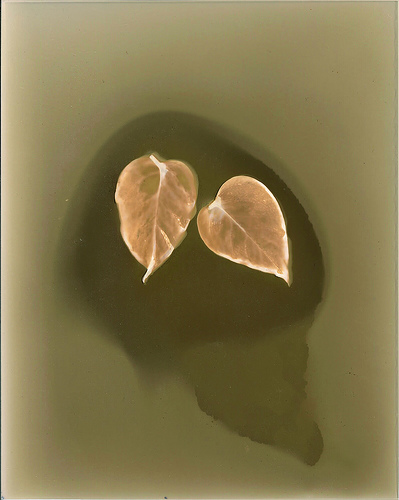
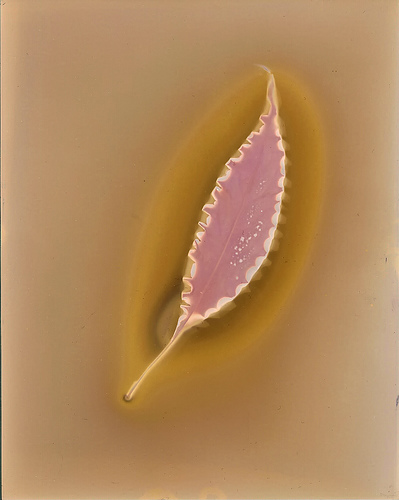
It's essentially a photogram made using the sun and a piece of moist organic material (ie: flower). The organic material is flattened against photo paper with a piece of glass on top, and then the sandwich is exposed to the sun (or UV light) for a period of time ranging from half an hour to a day. The volatile organic chemicals that are released by heating the organic material are responsible for making really funky colors on the photo paper.

After the exposure, the paper can simply be fixed using normal fixing and rinsing techniques (no development necessary).

Examples below:

http://www.flickr.com/photos/larryspinner/3242508397/

http://www.flickr.com/photos/larryspinner/3243343720/